Francisco Goya (1746-1828)
Goya was born in Spain at a time when his country was in the artistic doldrums.
He lived through the French Revolution, the Napoleonic wars, the Enlightenment – a time when Spain had lost its position as the world’s greatest marine power to England. Napoleon installed his brother as head of Spain.
Revolt occurred. The Church was attacked; it responded with a vengeance. Violence was the norm.
Goya became totally deaf at a young age, a bi-product of tapestry cartooning which carried with it a chemical hazard leading to deafness. Goya from then was secretive, obsessed with his health, fearing blindness. He painted royalty and secretly did prints – disasters of war – a bleak commentary of horror from the French suppression of Spanish uprisings.

Goya could do everything. He painted the Naked Maya 1789-1805 (Prado). The Inquisition forbade nudity. This isn’t a portrayal of nudity with its sense of innocence, this is sheer naked.
Up to this time nudity was introduced by a mythological or religious context. Here the young woman leers at the viewer, no props, no diversions, just sheer commercial lust. Goya was called up before the Inquisition on it. The Prime Minister Godoy, a ladies man, had a clothed Maya of the same woman by Goya on a pulley over the naked Maya and depending on the guest, Godoy would pull a certain pulley.
Paul Johnson a knowledgeable art critic doesn’t like the paintings. In the British Spectator, November 30, 1991 he said:
“Like nearly all the great reclining nudes, including those by Titian, Velazquez and Manet, it reflects the almost insoluble difficulties painters find in displaying the whole of a woman’s nakedness and, at the same time, suggesting repose. The girl’s body is not sunk in the cushions, as it ought to be; it is as though she is holding herself rigid to present the maximum display. Her legs are particularly awkward and her feet unnaturally placed. Her arms are stiff and do not support her head. Indeed, the head looks as though it belongs to another body and was simply stuck on, omitting the neck. I find it uncomfortable to look at this painting, for reasons which have nothing to do with sex.”
He has a point, although uncomfortable is a strange word. The painting is odd, I admit. It has become a work of immense notoriety.
At the time there was some suspicion that the model was none other than the Duchess of Alba, a leading member of the aristocracy. So long has the rumour persisted that in 1945 the then Duke of Alba had her grave disinterred so her height could be ascertained in order to refute the allegation. Paul Johnson indicates that the results of this review weren’t made public.
The Inquisition – an on and off again force – did ask Goya about the painting but there’s no record of his answer.

I will focus on The Shootings of May 3rd, 1808 (above) at the Prado in Madrid. There was a popular uprising in Madrid against the invading Napoleonic troops on May 2, 1808. Citizens attacked France’s Moorish Cavalry (also a painting by Goya – Prado). In response, France ordered execution by night.
This is a picture portraying the brutality of modern warfare from the victims’ perspective. The men to be shot have a horrified impotence in the face of the soldiers with rifles, an impersonal, godless, lethal force.
The key figure in the painting has yellow pants and blazing white shirt. His eye the big black corner ringed in white bulges with terror. He throws his arms up and out as though throwing his whole life in extremis in the face of his murderers. The arms portray crucifixion.
Blood beneath, the red of an abattoir.
Most of the victims have faces. Their killers do not. Anonymous killing is born.
The central figure is not idealized nor a martyr sacrificing himself to an idea in the expectation of salvation but a person no longer helped by faith, who has been denied human dignity, abandoned to brutality. The scene does not convey any morality, merely a reality in which morality has lost currency.
There is Saturn Eating Io, his son. The colours striking over a panicked populous (at the top of his arm gobs of bitumen black paint) – black was never like this – Van Dyck’s black is beautiful and subtle – no so here.
Goya’s black paintings in the Prado were originally in his farm outside Madrid filling large rooms. They are images of black grief, without logic, or apparent story line.
In the final analysis this museum is stamped by Goya’s black paintings. Unique. Painted at the end of his career, deaf, isolated, for his house – he surrounded himself with a vista vision of horror and goblins. The Spanish I suppose, like the people in Shakespeare’s time must have believed in spirits, personified by ghosts. The black paintings are slashes, gobs of black, black hats, black faces with white cadmium slashes all in a semi-circle rounded at the top as if in an Italian mirror of heaven, before the profile of a Bull (Anna supposes this may symbolize Spain — who knows but it seems right). They surround it in an arch of huddled terror – terror at the past, the present, suffused in the dark gloom, with the occasional look of suspended belief – but they all KNOW horror is for their bedtime. No real explanation is possible – it is living Hades.
Unlike van Dyck he relies on one shade of black but it is set off by acid lemon yellows, russets, Meissen yellows.
Goya’s paint surface, “so thick, corroded, and mortared; while one admires the daring of its contrasts of tone, the deep chasms of shadow against the glaring highlights that establish the structure of a face, the way (Hughes, 380) a chin or a cheek bone is dragged into being against the surrounding dark by a single oily swipe of a wide, loaded brush”
One of the panels is called The Witches’ Sabbath (Aquelarre).
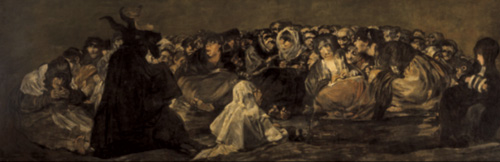
There is the devil shaped as a goat with back to the viewer lecturing a group of witches. Their howling faces, images of shriek, venom and full rant. The diatribe moulds the angry cauldron of witches into a collective howl.
A mother holds out her squirming baby as an offering to the devil.
The size of audience varies and their girth improbable with their robes puffed.
The faces, many a cutthroat here, the faces popping up – no rhyme nor reason – it’s crazy but the fear is REAL.
This mural prompts my impressions:
‘a huddle of black’
‘spider, spider, spider joined together’
‘black hills, streaks of acid yellow
an occasional gash of crimson’
‘squat toads, sitting, sliding, crouching, advancing’
‘a fog of evil’
‘a phantasm of morbid’
‘a dream could not be as dark’.
Goya added printers’ ink to the black, hence its lack of luminosity.
Half-submerged Dog (1819-23)
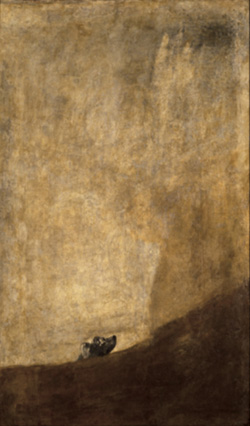 The dog at the end of the room sets off the room with an unexpected yellow, colourful spark. So wistful. The painting so tall. The dog’s gaze up to the high.
What does the yellow miasma mean? Can a dog be reflective?
All this is in the Prado – the great gallery of Madrid.
His black paintings in the Prado are so powerful that they surpass all of Bosch, Velázquez and Titian in the gallery. There is a room of shimmering El Grecos, as tall as a canvas can be, fluted energy and light but they can’t trump Goya’s sweep and swallow of black, more black, all blackness.

